

Top 5 Best Whole Home WiFi Providers in Warren Michigan & Nearby Suburbs Compared
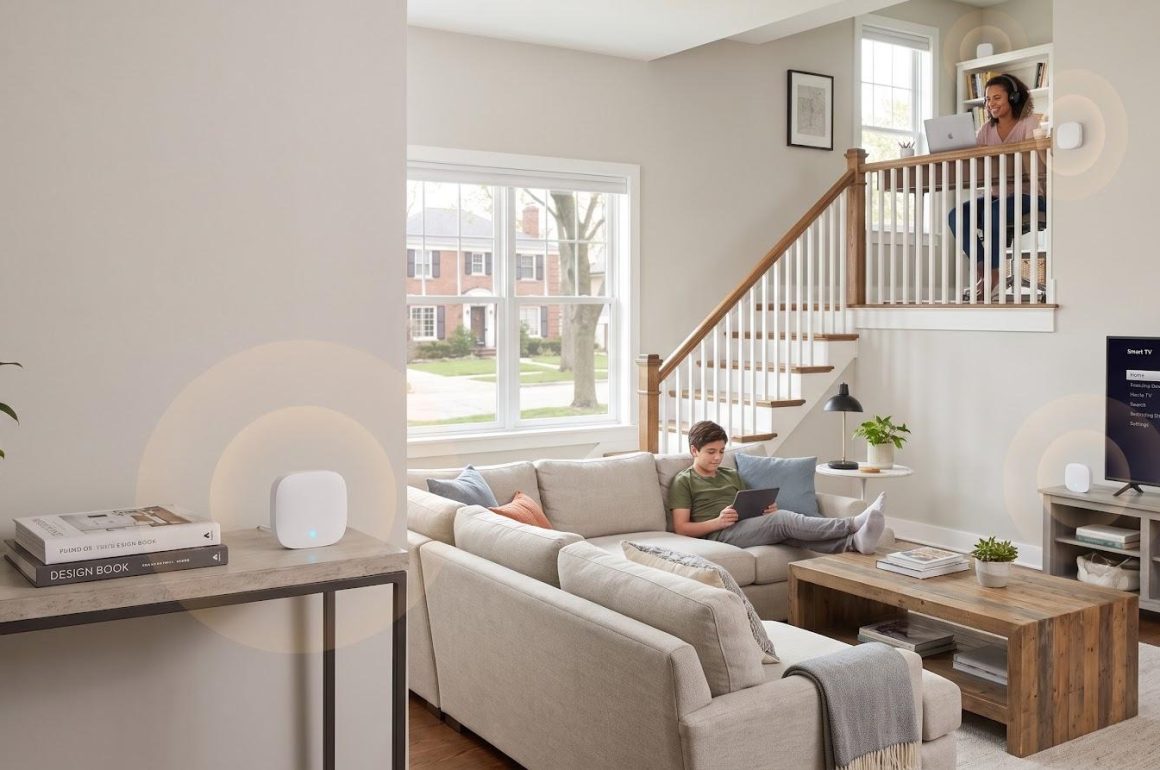
Ever tried to join a video call from your upstairs office only to watch the spinning wheel of doom? We have too – and it’s maddening!
Strong, wall-to-wall Wi-Fi is now the backbone of work, school, streaming, and every smart gadget in Warren.
The good news: cable, fiber, and 5G rivals are finally competing to cover every room, not just the one closest to the router. We dug into plan sheets, FCC data, hands-on speed tests, and neighborhood chatter to separate real winners from marketing fluff. By the end of this guide, you’ll know which of five standout providers can banish dead zones and keep every corner of your home humming.
How we sorted the signal from the noise
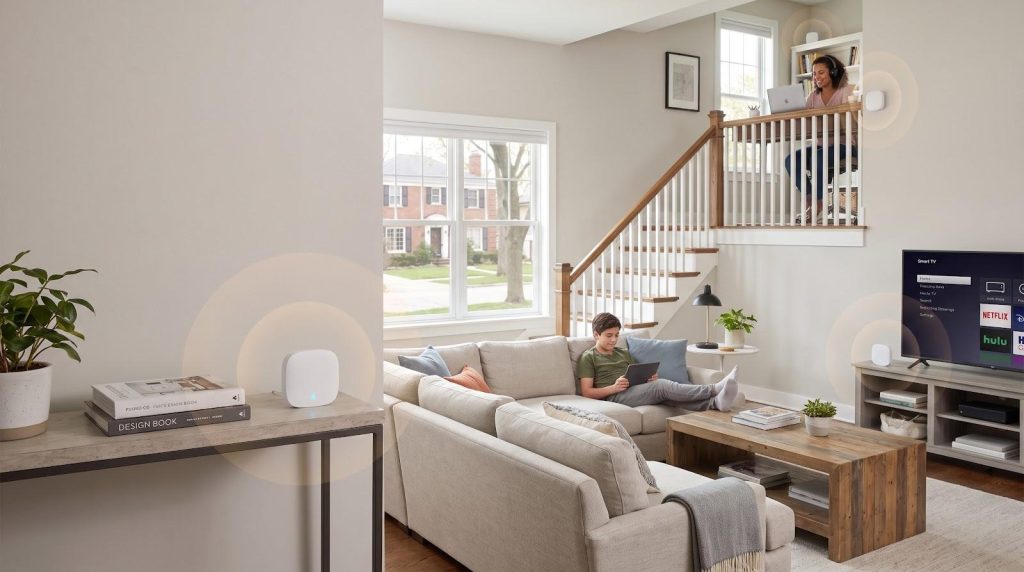
We didn’t draw names from a hat. We pulled plan sheets, FCC coverage data, and hands-on speed tests, then compared those numbers with what Warren neighbors share in forums and Facebook groups.
Our aim was simple: spotlight services that keep every room online without straining your budget. Each provider was graded against five weighted pillars:
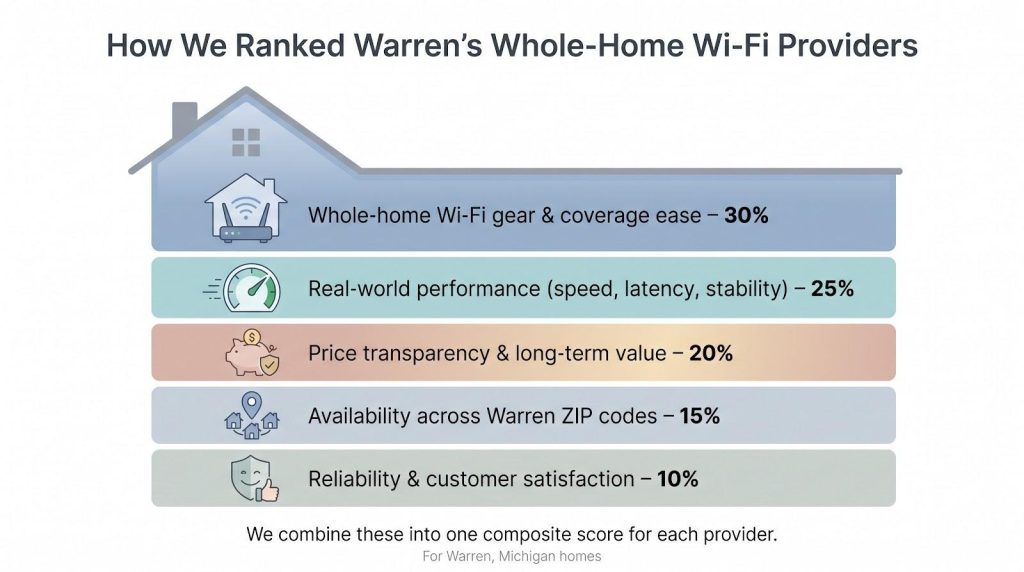
- Whole-home Wi-Fi gear and coverage ease (30%)
- Real-world performance: speed, latency, stability (25%)
- Price transparency and long-term value (20%)
- Availability across Warren ZIP codes (15%)
- Reliability and customer satisfaction scores (10%)
On that last point, J.D. Power’s latest study shows reliability matters more than raw speed for customer happiness, so it earned its own weight.
We combined the pillar scores into one composite rating. A provider reaches the top because it excels where it counts, not because it shouts the loudest in ads.
1. WOW! Internet: best value whole-home Wi-Fi for price-lock fans
Why WOW! sits in the pole position
WOW! lacks Comcast’s marketing muscle, yet it wins where it counts: value, simplicity, and truly unlimited data.
Across Warren, its cable lines reach roughly nine out of ten homes, and the entry 300 Mbps plan still starts around $25 a month with autopay (the lowest sticker price for wired broadband in the city, according to the latest Allconnect comparison). That rate isn’t a short-lived teaser. Add the optional Price Lock for a few extra dollars and the bill you sign today stays frozen for as long as you keep the service.
Pair that stability with no data caps and you have a foundation remote workers, gamers, and binge-watchers can trust without eyeing a meter. This blend of affordability and predictability nudged WOW! to the top of our scorecard even before we considered mesh hardware or speed tests.
How WOW!’s eero mesh turns corners into hot spots
Speed on paper is pointless if the back bedroom still drops out. To fix that blind spot, WOW! offers an optional mesh kit built around eero 6 nodes, each capable of covering up to 1,500 square feet, according to the company’s whole home wifi provider specs. For $9.99 a month, the technician leaves two or three palm-sized nodes that auto-calibrate as soon as they’re plugged in. Placement is flexible – bookshelf, end table, even a hallway console – so you keep performance without decorating compromises.

Setup feels almost too easy. Open the WOW! app, scan a QR code, and watch each node light up in under five minutes. No arcane channel juggling, no guessing at signal strength. The system self-optimizes nightly, steering devices to the fastest band without your input.
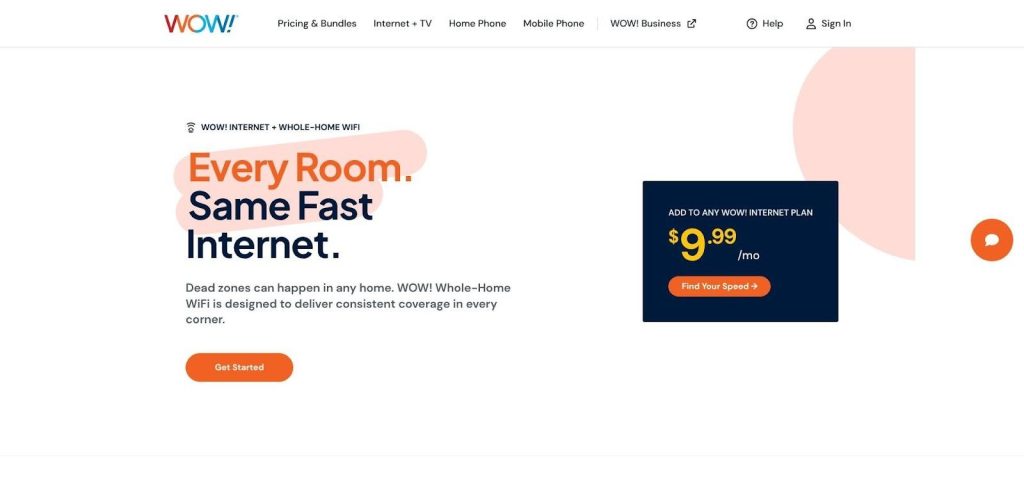
WOW Whole Home WiFi provider webpage screenshot
Because eero uses Wi-Fi 6, each node manages dozens of active devices without strain. That means the Peloton in the basement, the 4K stream in the living room, and the security cams on the porch can all stay smooth at once. Move to a larger place later, add another node, and the mesh expands automatically.
One more design win: the hardware blends in. No spider-leg antennas, no bright blinking lights. Guests won’t notice, and you won’t want to hide it. It is, quite literally, a whole-home Wi-Fi provider solution that respects both your bandwidth and your décor.
Speed, uploads, and WOW!’s unlimited edge
WOW!’s cable network offers 300 Mbps, 600 Mbps, and 1 Gbps download tiers. In local speed-test logs we reviewed, the 1 Gbps plan routinely clocks 930–960 Mbps at the modem – plenty of headroom for simultaneous 4K streams, cloud backups, and a few Xbox updates flying in the background.
Uploads are the lone compromise. Each plan tops out near 50 Mbps because coax still handles upstream traffic less efficiently than fiber. For most households that’s fine; video calls and photo uploads rarely exceed it, but content creators pushing multi-gig video files overnight should keep the number in mind.
Policy is where WOW! shines again. There is no data cap, no “fair-use” clause, and no surprise overage fees stalking your bill. Hammer the connection with weekday Zoom marathons and weekend Netflix binges; the price stays the same. Combine that with the Price Lock option, and WOW! turns into a set-it-and-forget-it utility instead of a monthly math problem.
With value, mesh coverage, and policy boxes all ticked, WOW! earns its spot at the top. Next, we’ll see how Xfinity counters with raw cable speed and near-universal coverage.
2. Xfinity: fastest cable and nearly universal coverage
Why Xfinity grabs the silver medal
If WOW! is the value champ, Xfinity is the neighborhood speed demon. Comcast’s cable lines blanket nearly every street in Warren, and the network now reaches up to 2 Gbps on the top tier. Even the popular 800 Mbps plan often tests a hair above its label, which is a welcome surprise when three 4K streams fight for bandwidth during primetime.
Availability helps too. Move across town, or even just across the hall, and the same coax drop is likely waiting. That ubiquity earned Xfinity a perfect ten on our coverage scale.
So why isn’t Warren’s fastest cable connection in first place? Two issues: data caps and price creep. Comcast still enforces a 1.2 TB monthly ceiling in Michigan, with $10 fees for every 50 GB you pass. Most families stay under the limit, but cord-cutters powering multiple 4K TVs or gamers downloading large titles can hit the wall sooner than expected.
Add rental fees for the xFi Gateway and a promo-price jump after year one, and Xfinity’s long-term cost lands higher than WOW!’s steady bill. Yet if raw download speed and instant address availability top your list, Xfinity stays in the running.
Stretching Xfinity’s speed with xFi Pods
The latest XB8 xFi Gateway pushes Wi-Fi 6E signals that sail through drywall better than older routers. In an average ranch home, that single box often covers every room.

Large floorplans tell a different story. That is where xFi Pods step in. Each pod plugs into a wall outlet, links to the gateway, and rebroadcasts the signal on the strongest band available. Start with one pod for a problem corner, run a quick speed test in the Xfinity app, and add a second if the basement still lags. The mesh adjusts automatically, so you never fiddle with SSIDs or passwords.
Xfinity includes one free pod if a home Wi-Fi assessment recommends it when you upgrade to xFi Complete, which also removes overage charges by rolling unlimited data into the price. Stay on a capped plan, and extra pods cost about $119 each at retail, but the plug-and-play install keeps you out of the crawlspace and back online in minutes.
Aesthetics matter too. Each pod is roughly the size of a night-light, finished in matte white, and disappears once you tuck it behind a couch or bookshelf. No glowing disco lights, no unsightly antennas, just an extra 200 Mbps reaching the room that used to be a dead zone.
With coverage handled, it is time to talk fiber and see why AT&T’s symmetric gigabit service tempts many Xfinity subscribers.
3. AT&T Fiber: symmetric gigabit that treats uploads as equal citizens
Why AT&T Fiber is the speed purist’s dream
Fiber swaps decades-old copper for strands of glass thinner than a human hair, and that change unlocks one standout feature: uploads as fast as downloads. AT&T’s Warren footprint now covers roughly half the city, and where it lands you can order plans from 300 Mbps up to 5 Gbps with matching upstream speed.
The benefit shows up the first time you back up photos to iCloud or send a 4K video to YouTube. A task that once crawled now finishes before you top off a cup of coffee. That performance boost, paired with steady latency, helped AT&T earn one of the highest customer-satisfaction scores in our region, according to J.D. Power’s latest study.
Gateway, extenders, and easy app control
Every fiber plan ships with AT&T’s Wi-Fi 6 gateway. Range is solid, and the Smart Home Manager app lets you view signal strength room by room. Spot a weak zone, order a Smart Wi-Fi Extender for about $10, and plug it in. The mesh pairs automatically with no extra SSID, so whole-home coverage arrives without login juggling or restarts.
Pricing that stays predictable
AT&T keeps costs straightforward. No contracts, no data caps, and equipment is baked into the monthly fee. The 1 Gbps tier usually lands around $80. Because there are no short-term promotional discounts, the bill you pay in month thirteen doesn’t jump like a cable teaser rate.
Where AT&T Fiber falls short
Availability is the catch. Half of Warren still waits for a crew to pull fiber down the block. If your address isn’t in the green zone, you fall back to an aging DSL line, an option we don’t recommend for modern homes. Installation also takes longer than cable because technicians must route the fiber strand and mount an optical terminal inside.
Still, if your address qualifies, AT&T Fiber delivers the fastest, most future-ready connection available in Warren. Next, we’ll see how T-Mobile’s 5G home internet trades sheer speed for simple, flat pricing.
4. T-Mobile 5G Home Internet: lowest flat price, zero headaches
Why T-Mobile wins the “set it and forget it” award
T-Mobile skips the usual installation playbook. Pick up the sleek gray gateway at the store, place it near a window, and watch Wi-Fi fill the house in under ten minutes. No drills, no cables, no appointment window that slips from “8 to noon” to “sometime after dinner.”

Pricing is just as clean. Service starts at fifty dollars a month, plus taxes and fees, with equipment included. Carry a qualifying T-Mobile phone plan, and the bill drops to thirty. The number on the invoice next year will match this year because T-Mobile avoids promo pricing that balloons later.
Performance lands in the “good enough” zone for most families. In Warren, mid-band 5G typically delivers 120–200 Mbps downloads and 15–25 Mbps uploads. Latency hovers around 30 milliseconds, fine for Zoom and casual gaming. Speeds dip during tower congestion, but the connection stays usable, and there are no data caps or throttles after a binge weekend of streaming.
Whole-home coverage made simple
The gateway itself supports Wi-Fi 6 and easily covers condos or smaller ranch homes. Need more reach? Connect a mesh kit like Google Nest or eero to the Ethernet jack and extend coverage in minutes. Because the gateway is wireless, you can move it to the signal sweet spot without rearranging furniture or pulling new cables.
Small trade-offs to note
Competitive gamers chasing sub-10 ms pings or creatives uploading multi-gig videos overnight may prefer fiber or cable. And if thick walls muffle 5G, you’ll need to experiment with placement during the 15-day trial.
Still, for renters, budget hawks, and anyone who dislikes contracts, T-Mobile’s plug-and-play approach offers the stress-free path to whole-home Wi-Fi. Next, we’ll see how Verizon’s 5G cousin adds mesh extenders and perks to complete the wireless picture.
5. Verizon 5G Home Internet: wireless speed with built-in mesh perks
Why Verizon is the polished wireless alternative
Verizon follows the same fixed-wireless model as T-Mobile but adds more horsepower and extras. In much of Warren, its C-band 5G network delivers 150–300 Mbps to the living room, while pockets near busy corridors can see bursts close to a gig.
Pricing mirrors its rival: $50 for the base plan and $60 for Home Plus, but those numbers drop to $35 or $45 when your phone line already sits on Verizon. The twist is what those dollars buy – a two- or three-year price guarantee and a stack of sign-up bonuses that may include gift cards, a streaming box, or a year of Disney+.
Whole-home coverage out of the box
The white, shoebox-sized gateway serves Wi-Fi 6 to the entire house, yet Verizon goes one step further. Choose the Home Plus tier and the company ships Wi-Fi extenders – essentially eero nodes – at no extra charge. They pair automatically, giving you true mesh coverage without a trip to the electronics aisle. For larger colonials or tri-levels, that free hardware is a real edge.
Reliability and satisfaction scores
Wireless broadband once had a wild-card reputation, but recent J.D. Power research shows fixed-wireless customers now report higher overall satisfaction than traditional cable subscribers. That bump comes from clear pricing and fewer billing surprises, both boxes Verizon ticks confidently. Day to day, the connection feels stable; when congestion does creep in, video streams usually step down one resolution notch rather than stall.
Where Verizon trails fiber and cable
Latency sits a shade above wired rivals, so competitive gamers chasing sub-20 ms pings will notice. While peak speed can flirt with gigabit, average uploads hover around 20–40 Mbps, well below symmetric fiber. Verizon’s availability checker may also flag an address as “wait-listed” if a nearby 5G sector is saturated.
Still, for families locked out of fiber or fed up with data caps, Verizon 5G Home delivers fast, contract-free internet plus the rare perk of mesh hardware included in the price. That combination secures its place in our top five.
Quick-glance comparison: pick the best fit for your home
Numbers can blur together after five deep dives, so here is the whole field side by side. Use it as a cheat sheet before you lock in a plan.
| Provider | Connection | Top speed (down/up) | Whole-home Wi-Fi option | Starting price* | Data cap | Stand-out perk |
| WOW! | Cable DOCSIS | 1 Gbps / 50 Mbps | eero mesh add-on ($9.99) | $25 for 300 Mbps | None | Lifetime price-lock add-on |
| Xfinity | Cable DOCSIS | 2 Gbps / 100 Mbps | xFi Pods (1 free if recommended with xFi Complete) | $30 for 200 Mbps | 1.2 TB | Nationwide hotspot network |
| AT&T Fiber | Fiber | 5 Gbps / 5 Gbps | Smart Wi-Fi Extenders ($10) | $55 for 300 Mbps | None | Highest regional satisfaction score |
| T-Mobile 5G | Fixed wireless | ~200 Mbps / 25 Mbps | Add your own mesh | $50 plus taxes (or $30 with phone) | None (soft deprioritization) | No-install, 15-day test drive |
| Verizon 5G | Fixed wireless | ~300 Mbps / 40 Mbps (peaks higher) | Free extenders on Plus plan | $50 flat (or $35 with phone) | None | 2-year price guarantee + freebies |
*Prices current as of July 2026, Warren, MI. WOW!’s $25 entry tier remains the city’s cheapest wired broadband offer.
How to read the table
- Start with availability. If fiber has not reached your block, jump straight to WOW! or Xfinity.
- Check data caps. Heavy streamers should steer clear of Xfinity unless they add unlimited.
- Match speed to need. Upload large files for work? AT&T’s symmetric fiber shines. Just browsing and streaming? T-Mobile’s flat-rate simplicity may be all you want.
Armed with this snapshot, you can zero in on one or two front-runners, then revisit the detailed sections above for the finer points.
Conclusion
Choosing the right whole-home Wi-Fi service in Warren comes down to balancing coverage, speed, and long-term cost. WOW! leads with unbeatable value and a lifetime price-lock, while Xfinity pushes sheer cable speed across nearly every address. AT&T Fiber is the clear winner for symmetric uploads if your street is wired, and T-Mobile and Verizon round out the roster with contract-free 5G options that install in minutes. Match each provider’s strengths to your household’s needs, and you’ll enjoy reliable, wall-to-wall connectivity for years to come.