

How Oversized Chandeliers Are Safely Lifted and Installed in Luxury Homes
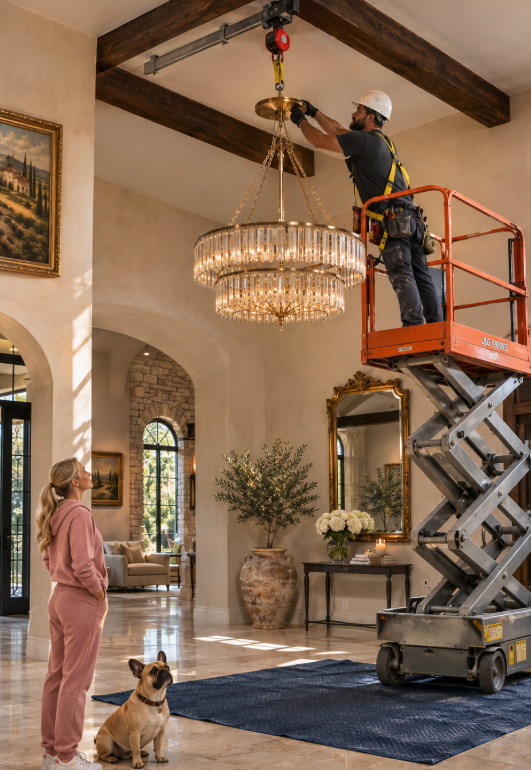
A beautiful chandelier can completely transform the appearance of a room. Whether suspended above a grand staircase, positioned in a two-story foyer, or hanging over an elegant dining table, oversized chandeliers create dramatic focal points that bring luxury and sophistication to a home.
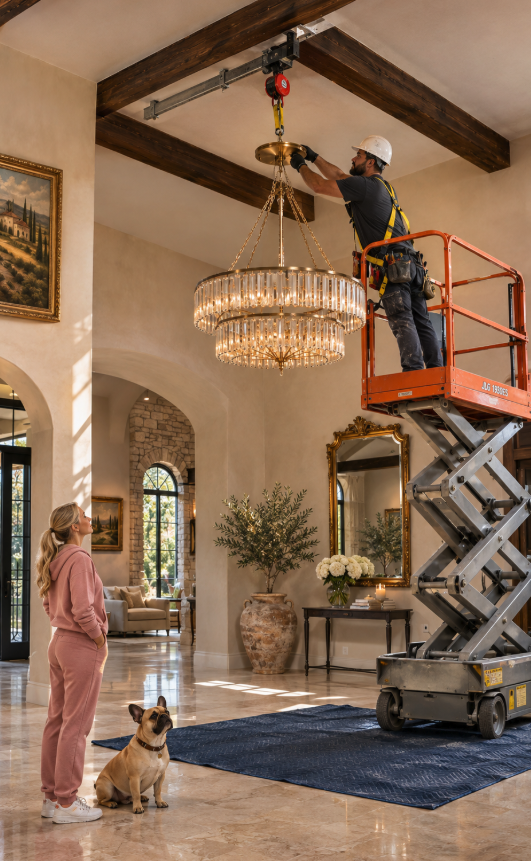
However, installing these impressive lighting fixtures is often far more complicated than hanging a traditional ceiling light. Large chandeliers can weigh hundreds of pounds, and some elaborate custom designs weigh considerably more. Their size, delicate materials, and elevated installation locations create challenges that demand careful planning and specialized equipment.
Professional installers often rely on heavy lifting equipment, rigging hardware, and engineered support systems to safely raise and position these fixtures. From electric chain hoists to lifting slings and shackles, the right tools help protect the chandelier, the surrounding interior, and the installation team.
Understanding how oversized chandeliers are installed offers a fascinating look at the technical work behind some of the most beautiful features of luxury home design.
Why Oversized Chandeliers Require Specialized Installation
Unlike standard residential lighting fixtures, oversized chandeliers pose several challenges during installation.
The most obvious concern is weight. A large chandelier may include heavy metal framing, hundreds of crystal elements, decorative glass panels, and multiple lighting components. These materials add to the fixture’s overall weight and make it difficult to handle manually.
Size is another important consideration.
A chandelier designed for a two-story foyer may measure several feet in diameter and extend well below the ceiling. Moving such a fixture through doorways, stairwells, and finished living spaces requires careful coordination.
The installation height also adds complexity. In homes with vaulted ceilings or grand entryways, workers may need to position the chandelier 20 feet or higher above the floor.
Attempting to lift and install a fixture of this size without proper equipment can damage the chandelier, surrounding architectural finishes, or the ceiling structure.
For these reasons, professional installers often use specialized lifting systems to handle the weight and positioning of oversized lighting fixtures.
Planning the Installation Before the Chandelier Arrives
Successful chandelier installation begins well before the fixture is lifted into place.
Installers first review the chandelier’s dimensions, total weight, mounting requirements, and assembly instructions.
They must also evaluate the room where the fixture will be installed.
Important considerations include ceiling height, available floor space, access routes, nearby architectural features, and the electrical connection’s location.
In luxury homes, decorative elements such as curved staircases, marble floors, ornate moldings, and custom railings can complicate equipment placement.
For example, installing a chandelier above a sweeping staircase may require a different approach than installing one in an open foyer with a flat floor.
Installers may use laser measuring tools to verify ceiling heights and clearances before selecting lifting equipment.
Another critical step is to confirm that the building structure can support the chandelier.
Heavy lighting fixtures cannot be attached to ordinary ceiling drywall or to standard electrical boxes that are not rated for the load. A qualified structural professional may need to evaluate the ceiling framing and design an appropriate support system.
The permanent mounting arrangement must safely support the fixture’s weight and comply with applicable building and electrical codes.
Using Electric Chain Hoists to Lift Large Chandeliers
One of the most useful tools for installing oversized chandeliers is an electric chain hoist.
Electric chain hoists use a powered lifting mechanism to raise and lower heavy loads in a controlled manner.
For chandelier installations, a properly rated hoist can help installers gradually raise the fixture while monitoring its position and clearance.
This controlled movement is especially valuable when handling delicate crystal chandeliers that could be damaged by abrupt motion.
Some luxury homes have a dedicated chandelier-lift system built into the structure during construction.
These systems allow large chandeliers to be lowered for cleaning, maintenance, and bulb replacement without requiring workers to reach the fixture at ceiling height.
However, the lifting equipment must be connected to an engineered support structure capable of carrying the intended loads.
A hoist should never be attached to decorative ceiling materials or to an unverified structural member.
Before lifting begins, confirm the equipment’s rated capacity, mounting configuration, and compatibility with the chandelier..
Chain Hoists and Lever Hoists for Precise Positioning
Although electric chain hoists are convenient for larger installations, manual lifting equipment can also be useful in certain situations.
Manual chain hoists allow workers to raise a load with a hand-operated chain.
They can provide controlled lifting when electrical power is unavailable or when the installation requires relatively slow movement.
Lever hoists, sometimes called come-alongs, may also be used in engineered rigging arrangements for controlled positioning or adjustments.
For example, a lever hoist might help adjust the position of a temporary lifting assembly during installation.
However, lever hoists should be used only in configurations approved for the equipment and for the intended direction of loading.
The choice between electric and manual lifting equipment depends on the chandelier’s weight, available space, required movement, and installation design.
In every case, lifting equipment must have sufficient rated capacity and be operated by personnel who are familiar with its limitations.
The Importance of Lifting Slings and Rigging Hardware
A hoist provides the lifting force, but additional rigging is often needed to connect the chandelier to the lifting system.
Because chandeliers are decorative fixtures rather than conventional industrial loads, installers must be especially careful when choosing attachment points.
The chandelier manufacturer may provide designated lifting points or specific handling instructions.
When no suitable lifting arrangement is provided, a qualified professional may need to develop a custom solution.
Synthetic Lifting Slings
Synthetic web slings and round slings are commonly used in lifting applications because they are flexible and lightweight.
When appropriate for the fixture and for an approved lifting arrangement, these slings can help support components without exposing finished surfaces to direct contact with steel rigging.
However, delicate chandelier arms, decorative metalwork, and crystal elements should never be assumed to support lifting forces.
Slings must connect to suitable load-bearing points or an approved lifting fixture.
Protective materials may also be necessary to prevent abrasion or damage.
Wire Rope Slings
Wire rope slings offer strength and durability for many heavy lifting applications.
In chandelier installation projects, they may be used as part of a temporary lifting assembly or as part of an engineered lifting frame.
Their use depends on the required capacity, connection geometry, and fixture compatibility.
Avoid letting wire rope touch delicate chandelier parts, as it can damage their decorative finishes.
Shackles and Master Links
Shackles and master links are essential rigging components used to connect lifting equipment.
A properly rated shackle may connect a sling assembly to a lifting fixture, while a master link can serve as a common connection point for a multi-leg sling arrangement.
All components must be selected based on their working load limits and the expected loading conditions.
The connection arrangement should also prevent unintended movement, side loading, or contact with fragile chandelier components.
When Custom Lifting Beams and Frames Are Needed
Some oversized chandeliers have unusual shapes that make them difficult to lift from a single point.
Large circular chandeliers, multi-tiered fixtures, and elaborate custom lighting installations may require specialized lifting frames.
A custom lifting beam can provide multiple attachment points and help distribute lifting forces across an approved support arrangement.
Similarly, a spreader beam can maintain separation between lifting connections when the load geometry requires it.
These devices are especially useful when a chandelier’s size makes it difficult to maintain stability during lifting.
For example, a large circular chandelier may require a purpose-built lifting fixture that supports its structural frame at several designated points.
An engineered lifting arrangement can help maintain the fixture’s orientation and reduce unwanted movement as it approaches the ceiling.
Custom lifting devices should be designed and rated for the specific application rather than improvised on-site.
Protecting Luxury Interiors During Installation
Installing an oversized chandelier is not only about safely lifting the fixture. It also involves protecting the home’s finished surfaces.
Luxury interiors often feature expensive materials such as natural stone flooring, hardwood, decorative plaster, and custom millwork.
Moving heavy equipment through these spaces requires additional precautions.
Installers may use protective floor coverings, load-distributing platforms, and carefully planned access routes.
Scaffolding, personnel lifts, or other suitable access equipment may be required to reach the installation area.
However, the weight and movement of this equipment must be considered, especially when working over finished floors or near staircases.
Before installation begins, contractors should determine whether the floor can support the equipment and any concentrated loads.
Nearby furniture and decorative items may need to be removed or protected.
Setting up a controlled work area also keeps homeowners, visitors, and other workers away from the space beneath a suspended chandelier.
How Oversized Chandeliers Are Positioned and Secured
Once the lifting equipment and structural supports are in place, installers can begin positioning the chandelier.
Depending on the manufacturer’s instructions, some chandeliers are lifted as complete assemblies, while others are partially assembled before installation.
Removing delicate crystal elements before lifting may reduce the risk of damage, provided the manufacturer permits it.
The fixture is then connected to its approved lifting arrangement and raised gradually.
During the lift, workers monitor the chandelier’s orientation, clearances, and movement.
As the chandelier approaches its final position, installers carefully align it with the permanent mounting system.
Fully secure the fixture to its engineered support before disconnecting the temporary lifting equipment.
A qualified electrician should complete or verify electrical connections in accordance with applicable electrical codes.
Once the chandelier is properly mounted and connected, installers can complete any remaining decorative assembly.
This may include attaching crystal strands, installing glass shades, adjusting decorative elements, and checking that the fixture hangs level.
Finally, the team tests the lighting system to confirm proper operation.
Designing Homes With Chandelier Installation in Mind
For homeowners planning a new luxury residence or major renovation, consider chandelier installation during the architectural design stage.
A large statement chandelier may require reinforced ceiling framing, dedicated mounting hardware, additional electrical provisions, or a permanent lifting system.
Planning for these requirements early can simplify installation and reduce the need for modifications after construction is complete.
Architects, interior designers, structural engineers, and lighting specialists can work together to determine the appropriate location and support requirements.
For chandeliers above grand staircases or double-height entryways, consider maintenance access.
A permanent chandelier hoist system may make future cleaning and servicing significantly easier.
Beyond practical considerations, the chandelier’s proportions should complement the surrounding architecture.
An oversized fixture should create a dramatic visual impact without overwhelming the space or interfering with movement below.
Balancing design with installation requirements helps ensure that the finished chandelier is both beautiful and practical.
Final Thoughts
Oversized chandeliers are among the most striking decorative features found in luxury homes. Their impressive dimensions, intricate designs, and elegant materials can transform ordinary rooms into extraordinary spaces.
Behind that visual impact, however, is a carefully coordinated installation process involving structural planning, electrical expertise, and specialized lifting equipment.
Electric chain hoists, manual chain hoists, synthetic lifting slings, wire rope slings, shackles, and custom lifting beams can all play important roles in handling large lighting fixtures when properly selected for the application.
By working with qualified professionals and planning the installation carefully, homeowners can enjoy the beauty of an oversized chandelier without compromising the structure’s safety or the fixture’s integrity.
The result is more than a beautiful lighting feature. It is a carefully engineered installation that brings together interior design, craftsmanship, and modern lifting technology.